Holy Matrimony
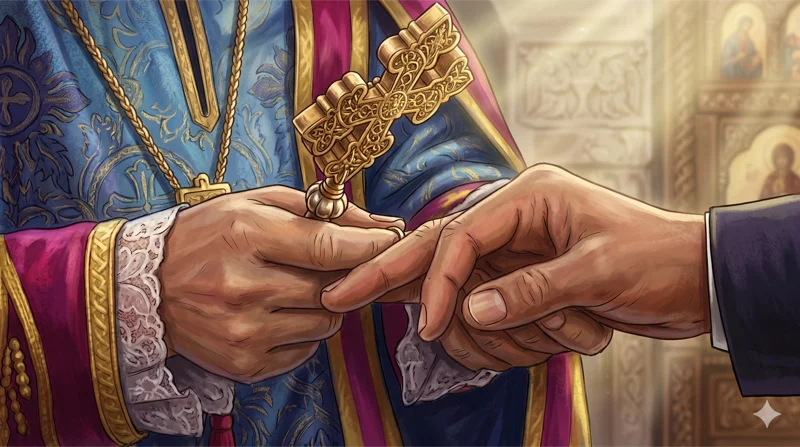
The priest places the blessed ring — it is God who unites the couple.
A Covenant, Not a Contract
Holy Matrimony is God who unites man and woman. The Church does not merely witness this union; she is the effective instrument of the marriage itself. When the priest blesses the rings and crowns, he acts as Christ's representative, calling down the blessing and presence of God upon the couple. This is why marriage in the Orthodox tradition is a mystery (sacrament). It is a divine action made visible and real through the liturgical action of the Church.
Unlike a contract that can be broken, a covenant is a sacred bond created by God. The couple enters into marriage not as isolated individuals pursuing personal happiness, but as members of Christ's Body, the Church. They promise themselves to each other before God and witnesses, understanding that their union reflects Christ's love for His Church, a love that is unconditional, self-sacrificing, and eternal.
The sacrament transforms marriage from a social arrangement into a pathway to holiness. Through the challenges and joys of married life, the couple grows in love, forgiveness, patience, and sacrifice, the very virtues that lead us to God. Marriage becomes a means of salvation, a school of love where two broken people learn to love each other as Christ loves us.
The Five Steps
The Opening Prayers and Preparation
The service begins with opening prayers invoking divine blessing upon the couple. The priest, vested in his full liturgical vestments, stands before the bridegroom and bride. The Church gathers to witness and participate in this sacred mystery. Hymns are sung, calling upon God to bless this union with His grace and mercy. The couple stands before the altar, acknowledging that they are entering into this marriage not for themselves alone, but as members of Christ's Body, the Church.
First Order: The Blessing of the Rings (Betrothal)
The rings are brought forward and blessed by the priest. These rings symbolize a binding betrothal, a sealed contract made before God. The rings represent the Old Testament patriarchs (Abraham, Isaac, Jacob) and their covenants with God, now renewed in the marriage covenant. The priest, as Christ's representative, places the rings upon the fourth finger (the ring finger) of each person's right hand while saying: "Receive from Him the invisible grace of His mercy." The rings are placed not by the couple themselves, but by the priest, signifying that it is God who unites them, not merely their own choice. This first order constitutes half of the marriage, the binding betrothal.
Scripture Readings and Liturgical Witness
The Epistle (from Ephesians) and Gospel (from Matthew) are proclaimed. These readings ground the marriage sacrament in apostolic tradition and Christ's teaching. The Epistle reveals the nature of Christian marriage: husbands are to love their wives as Christ loved the Church, and wives are to submit to their husbands as to the Lord. The Gospel proclaims Christ's words about marriage: "What therefore God has joined together, let no one separate." Through these readings, the couple hears God's Word about what marriage truly is, not a personal arrangement, but a divine mystery.
Second Order: The Blessing of the Crowns (Wedding Feast)
This second order constitutes meshtutho, the wedding feast, and completes the marriage. The crowns (traditionally represented by a necklace with a cross pendant in Indian custom) are blessed by the priest. These crowns signify that the bridegroom and bride are now crowned as king and queen of a newly established family on earth. The priest waves his right hand over the crowns in the sign of the Cross three times, invoking the blessing of the Trinity while saying: "Blessed and perfect be these crowns and the heads upon which they are placed." The couple is now fully married: crowned, blessed, and recognized by the Church as a new domestic church.
The Sign of Peace and Communion
The couple exchanges the sign of peace with the priest and each other, embracing in the presence of the Church. If the marriage takes place during or near the Divine Liturgy, the newly married couple receives Holy Communion together for the first time as husband and wife. This shared communion deepens their union, as they participate together in the Body and Blood of Christ, the source of all grace and the foundation of their marriage.
The Symbolism of the Sacrament
- Circle without end: The rings symbolize eternity and the binding nature of the covenant. They are not broken or removed, just as the marriage bond is not to be broken.
- The Patriarchs: The tradition of rings recalls Abraham, Isaac, and Jacob, whose covenants with God were sealed and binding. Marriage, too, is a sealed covenant made before God.
- Authority and responsibility: The crowns signify that husband and wife are the king and queen of their family. They rule together with love and justice, modeling Christ's kingship.
- Victory and blessing: Crowns represent divine blessing and victory. The couple is called to conquer evil and build a Christ-centered home through love, sacrifice, and mutual support.
- Christ at the center: The cross pendant worn with the crown reminds the couple that Christ must be the head of their marriage. All love, all decisions, all life flow from Christ the Redeemer.
- The fourth finger: In ancient times, it was believed this finger contained a vein directly to the heart. The ring on this finger symbolizes that the marriage bond goes directly to the heart, affecting the whole person.
Preparing for Marriage
- Confession and receiving absolution before marriage
- Regular prayer together as a couple
- Understanding marriage as a sacrament, not just a social event
- Growing in knowledge of your faith and your partner's faith
- Seeking God's will, not just personal desires
- Fasting or prayer before the wedding day
- Meet with the parish priest well in advance
- Discuss marriage counseling or pre-marital guidance
- Arrange the date, time, and details of the ceremony
- Clarify expectations about the sacrament
- If either person has been previously married, discuss Church requirements
- Understand the obligations and blessings of Christian marriage
- Invite your church family to witness and pray with you
- Choose godparents or sponsors who will support your marriage
- Plan the ceremony in consultation with the priest
- Understand the meaning of the rituals you will participate in
- Foster community support for your new marriage
A Note on Church Requirements
Marriage in the Malankara Orthodox Church requires both persons to be baptized. Mixed marriages (between Orthodox and non-Orthodox) require special permission from the diocese. Those previously divorced must seek guidance from the priest, as the Church has specific pastoral approaches. Always speak with your priest early in the engagement to ensure your marriage can be celebrated in the Church.
Building a Domestic Church
After the crowning, the real work begins. Marriage is not the end of the journey but the beginning. The newly crowned king and queen are called to build together what the Church calls a domestic church, a home where Christ is present, where prayer is offered, where love is lived out in all its forms: sacrifice, forgiveness, faithfulness, and mutual support.
The husband's role is modeled on Christ: to love his wife sacrificially, putting her needs and spiritual growth before his own. He is the priest of the family home, leading his wife and children in prayer and pointing them toward Christ.
The wife's role is to be the heart of the family, nurturing love and creating an atmosphere where Christ is known and obeyed. She is not subordinate in dignity, but called to a different expression of leadership, the leadership of wisdom, compassion, and spiritual discernment.
Together, husband and wife create a sanctuary. Children born to such a marriage are baptized into a faith that is lived, not merely professed. Guests who enter such a home encounter Christ's presence. Prayer, fasting, regular communion, and acts of mercy characterize the family's rhythm of life.
And when difficulties come, and they will, the couple returns to the sacraments: confession for forgiveness, the Eucharist for strength, and the intercessions of the Church for grace to endure and to love ever more deeply.
Preparing to Be Crowned
If you are considering marriage or engaged to be married, speak with your parish priest. We are here to help prepare you spiritually for this sacred step and to witness the blessing of your union before God and the Church.
Contact the Parish