Holy Orders
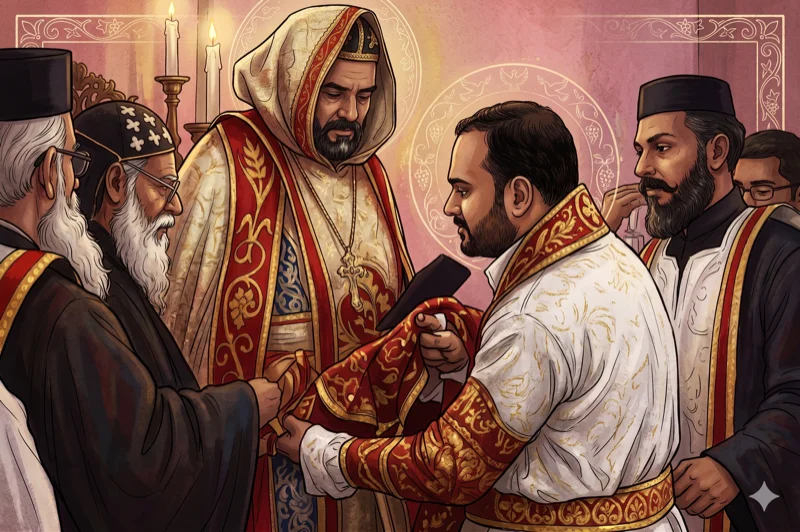
A bishop ordains through the laying on of hands — apostolic succession unbroken since St. Thomas.
A Sacrament of Apostolic Succession
Holy Orders is a sacrament, a visible and tangible sign of God's invisible grace. Just as baptism initiates a believer into Christ's Body, and marriage unites a couple in God's sight, ordination sets apart a man to serve Christ and His Church in a special way. Through this sacrament, the gifts and functions once given to the Apostles are transmitted to ordained ministers through an unbroken chain of laying on of hands stretching back to Christ Himself.
This is apostolic succession, the very lifeblood of the Orthodox Church's authority and authenticity. When a bishop lays his hands on a candidate for ordination, he does not do so on his own authority, but as the successor of the Apostles, passing on what the Apostles received from Christ. Our Church traces this unbroken succession back to St. Thomas the Apostle, who came to India in 52 A.D., converted many, and ordained the first presbyters and bishops from among the faithful.
Because priesthood is a sacrament, ordination is irreversible. The character imprinted upon the priest through ordination is indelible. It marks him forever as one set apart for the service of God's people. This character does not depend on the priest's personal worthiness; rather, those who receive the sacraments from a priest's hands with good intention and true faith will receive spiritual strength, regardless of the priest's human failings.
The Three Orders
The Deacon (Deaconus)
The deacon is the first of the three orders of the ordained priesthood. The word "deacon" comes from the Greek diakonos, meaning "servant." Deacons serve alongside priests and bishops in the liturgy and in pastoral care. In the Divine Liturgy, deacons read the Gospel, lead the people in response, make petitions on behalf of the congregation, and assist the priest at the altar. A deacon may eventually be ordained to the priesthood, at which point he becomes a priest.
The Priest (Presbyter)
The priest shares in the functions of the episcopacy and leads a local parish. A priest has the authority to celebrate the Divine Liturgy (the Eucharist), hear confessions, perform baptisms and chrismations, bless marriages, anoint the sick, and provide pastoral care to the faithful. The priest is a guide, making earthly beings heavenly beings. He is an ambassador of God who represents Christ to his congregation and represents the people before God in intercessory prayer. A priest may be married (if married before ordination) or celibate. The bishop may eventually promote a priest to the rank of Archpriest or Periodeute (traveling priest).
The Bishop (Diocesan Metropolitan)
The bishop is the chief shepherd and administrator of a diocesan church. A bishop has all the powers of a priest, plus the exclusive authority to ordain other bishops, priests, and deacons. The bishop is the successor of the Apostles and presides over the sacraments, pastors his flock, and ensures the faith is correctly taught and preserved. Only unmarried men may become bishops, a practice established in the sixth century to allow the bishop to devote himself entirely to the care of his diocese and the spiritual welfare of all his people. Bishops are selected from the celibate clergy (monks or unmarried priests who have vowed celibacy).
Apostolic Succession: An Unbroken Chain
The history of our Church begins with St. Thomas the Apostle. In 52 A.D., St. Thomas came to India and established the Church in Kerala. He converted many believers, including members of the Four Ancient Families (Pakalomattam, Sankarapuri, Kalli, and Kaliankal), and ordained presbyters and bishops from among these faithful. The Church he established has never ceased to exist. For nearly two thousand years, an unbroken chain of apostolic succession has been maintained.
What is apostolic succession? It is the principle that the authority to ordain, teach, and govern the Church passes directly from the Apostles through their successors (bishops) down to the present day. This is not a matter of ideas or traditions passed down through writings alone, but of living authority transmitted through the laying on of hands. When our Metropolitan ordains a priest, he does so not on his own authority, but as a successor of St. Thomas, who received authority from Christ Himself.
Why does this matter? Because it guarantees that the Church today is the same Church that the Apostles founded and that Christ established. Our bishop is not a self-appointed preacher or a CEO hired by a board. He is the successor of the Apostles, ordained through an unbroken chain stretching back two thousand years to Christ. When we receive a sacrament from a priest's hands, we receive it from hands that are part of this apostolic chain. This gives us confidence that what we receive is authentic, that it comes with the authority of Christ Himself.
The Sacrament of Ordination
- The central action of ordination is the laying on of hands by the bishop, invoking the Holy Spirit to impart the grace necessary for ministry.
- This gesture echoes the practice of the Apostles themselves, who ordained their successors through the laying on of hands.
- The bishop must be convinced the candidate has been called by God, has studied theology, demonstrated moral character, and is ready to serve sacrificially.
- The assembled clergy and people pray, asking God to bestow the gifts of the Holy Spirit: wisdom, discernment, compassion, faithfulness, and courage.
- The prayers acknowledge the candidate is human and weak, but that God's grace is sufficient to sustain him in ministry.
- The priest being ordained prays: "I am unworthy, but by Your grace, I am made worthy to serve."
- The newly ordained is invested with vestments appropriate to his order, each carrying spiritual meaning: the stole symbolizes the priest's obligation to guide his flock.
- Through ordination, the priest receives sacramental authority: the power to celebrate the Eucharist, hear confessions, and administer sacraments.
- This authority comes from apostolic succession, not from education or popular vote. God's grace operates independently of human unworthiness.
Called to the Priesthood
- A sense of God's calling to priestly ministry
- Deep love for Christ and His Church
- Willingness to serve sacrificially, putting the congregation's needs before personal desires
- Recommendation by one's parish community or self-application to the Diocese
- Examination by the Bishop to discern the call
- Enrollment in theological seminary (minimum three years of study)
- Study of Scripture, Church history, theology, and liturgics
- Training in pastoral care, counseling, and spiritual direction
- Practical experience in parish ministry
- Certification of fitness by the seminary principal
- Regular confession and communion
- Prayer, fasting, and monastic practices
- Study of the Fathers of the Church
- Growth in humility and self-knowledge
- Readiness for the sacrifices priesthood requires
Marriage and Celibacy
Priests may marry, but only before ordination. A man may be ordained as a priest if he is married or unmarried. However, once ordained, a priest cannot marry. Only men who are unmarried (or widowed) can become bishops; this has been the practice since the sixth century. A priest who feels called to higher ministry may take vows of celibacy and eventually be consecrated as a bishop.
The Priestly Life
- A guide, making earthly beings heavenly. The priest comes as a servant, following Christ who washed His disciples' feet.
- Celebrates the Eucharist, the central act of priesthood, standing in the person of Christ at the altar.
- Hears confessions and pronounces absolution. The priest does not judge; he forgives in Christ's name.
- Administers the sacraments from baptism to anointing, bringing God's grace to every moment of life.
- Pastor and spiritual father, knowing his congregation, visiting the sick, counseling the troubled, guiding the young.
- And yet, the priest remains a sinner. The power of the sacraments depends on Christ, not on the priest's personal virtue.
- Priesthood is a calling, not a career. Deep joys of serving Christ, shepherding souls, and witnessing God's grace, but also sacrifice: the priest's time is never fully his own.
- The Church does not idealize celibacy. Married or celibate, the priest is called to the same holiness. Both paths are sacred; both require grace.
- The priest must grow in holiness constantly. He must be the first to repent, the first to confess, the first to pray.
- The priest is not alone. He stands within the apostolic succession, strengthened by his congregation's prayers. When he is weak, God is strong. This is the mystery of Holy Orders.
Considering a Calling to Priesthood?
If you sense God's call to priestly ministry, speak with your parish priest or bishop. Prayer, discernment, and spiritual guidance will help you understand whether this vocation is truly for you. The Church needs faithful, humble, and prayerful priests who will shepherd God's flock with love.
Contact the Parish